

SMPTE timecode LTC VITC: variants for broadcast
SMPTE timecode LTC and VITC are the classic timestamp formats for audio and video. How do they compare, and what role does the modern SMPTE 2059-2 PTP variant play in broadcast?
The three variants
- LTC: the timecode on an audio track. It travels over an ordinary audio cable, ideal for live events and lighting control.
- VITC: the timecode hidden inside the video signal itself. It stays readable when the picture is paused.
- SMPTE 2059-2: the modern variant, which distributes the time over an IP network (based on PTP).
In practice
Most studios are in a transition phase and use several variants at once. One modern master clock such as the Masterclock GMR6000 delivers them all together. We help you choose what suits your setup.
Where timecode comes from
In 1969 the SMPTE standardised a time coding (SMPTE 12M) to label every frame of a video or audio tape, so devices could run in sync. The first variant, LTC, put the code on an audio track; VITC followed, in the video signal itself. With the move to IP broadcast, SMPTE 2059-2 is now emerging (PTP over IP, part of the SMPTE ST 2110 suite).
LTC (Linear Time Code)
An audio-frequency coding: 80 bits per frame, bi-phase-mark encoded. It travels over an ordinary audio cable (XLR, jack, coax) up to about 300 m. Independent of video, so ideal for audio-only work and lighting control. Downside: at standstill the timecode stands still too, and it costs one audio channel.
VITC (Vertical Interval Time Code)
Sits in the invisible lines of the video signal (vertical blanking interval). No separate cable needed, stays readable at standstill and single-frame stepping, but does not exist without a video signal.
The 29.97 fps problem
NTSC video runs at 29.97 fps, not 30. Counting at 30 fps while the picture runs at 29.97 leaves you 3.6 seconds off after one hour. Solution: drop-frame timecode skips frame numbers so the code matches the wall clock again (marked with `;`). Non-drop-frame (`:`) does not. At European rates (25/50 fps) this does not occur; only NTSC rates (29.97/59.94) require drop-frame.
SMPTE 2059-2 and PTP
In IP broadcast (SMPTE ST 2110) the master clock distributes the time via PTP according to SMPTE 2059-2 (Default Profile on domain 127, sub-microsecond). Each device derives its timecode from that PTP time. A modern master clock often delivers everything at once: SMPTE 2059-2, black burst, tri-level sync, LTC and VITC.
Want the full explanation with all frame rates and sources? Switch to Expert above.
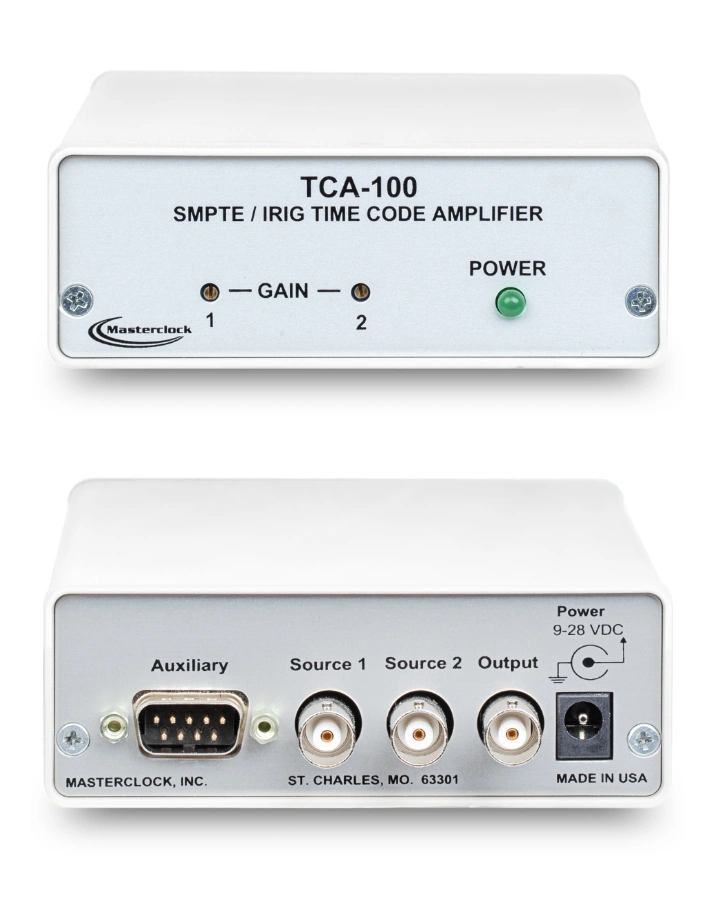
From theory to practice: browse the time code products in the Masterclock range from Daylight.
In every broadcast studio, post-production suite and live-event truck something runs that looks like a timestamp: hours:minutes:seconds:frames. That is SMPTE Timecode, the standard that has made it possible since 1969 to synchronise audio, video, lighting cues and automation with each other. This article explains the three historical variants (LTC, VITC, drop-frame) and how the modern IP era builds on top of them with SMPTE 2059-2 PTP.
Where does SMPTE Timecode come from?
In 1969 the Society of Motion Picture and Television Engineers (SMPTE) standardised a time-coding known as SMPTE 12M. Goal: a timestamp that could be referenced on every frame of a video or audio tape so that different devices could run in sync. The first variant, Linear Time Code (LTC), placed the code on an audio track. Vertical Interval Time Code (VITC) followed, placing the time in the non-visible lines of the video signal itself. With the transition to IP-based broadcast, SMPTE 2059-2 is now in the picture: timecode based on PTP over IP, part of the SMPTE ST 2110 suite.
What is LTC (Linear Time Code)?
LTC is an audio-frequency encoding of timecode. The signal consists of bi-phase-mark-encoded bits, with a frequency between approximately 1.2 kHz and 2.4 kHz depending on the frame rate. Every frame contains 80 bits: 32 for the time, plus user bits, sync bits and flags.
Characteristics:
- Transport via standard audio cable (XLR, jack, coax). Lengths up to 300 m without an amplifier are typically achievable.
- Readable at any standard speed except still-frame: when stopped, the timecode also stops, so devices lose their reference.
- Independent of video: you can generate LTC without a video source, ideal for audio-only post-production and lighting-cue synchronisation.
- One audio channel sacrificed: LTC consumes a full audio track, which is rarely an issue in modern digital workflows but is in tape environments.
What is VITC (Vertical Interval Time Code)?
VITC places the timecode in the vertical blanking interval (VBI) of the video signal, the non-visible lines between frames. No separate cable needed: the timecode travels along with the video signal.
Characteristics:
- Readable at standstill and single-frame stepping: VITC refreshes in every frame, so even a paused tape returns the correct timecode.
- No separate audio track needed: all audio channels remain available.
- Integrated with the video signal: edit suites that parse the video stream get timecode for free.
- Tied to the video signal: no video means no VITC. For audio-only workflows LTC is needed.
What is the 29.97 fps problem and how does drop-frame solve it?
A frustrating artefact of NTSC colour television: the frame rate is 29.97 fps, not the neat 30 fps that appears in datasheets. Reason: in 1953 NTSC's colour-burst frequency had to be aligned with a sub-multiple of the audio carrier, which dropped the frame rate from 30.000 down to 29.97002…
That creates a counting problem for timecode. If you count timecode at 30 fps but your video runs at 29.97 fps, after an hour your timecode runs 3.6 seconds ahead of the actual frame count. For real-time broadcast: catastrophic.
Two solutions:
Drop-frame timecode (DF): for every minute that is not divisible by 10, two frame numbers are "skipped" in the count. So the timecode does not count "00:00:59:29 → 00:01:00:00" but "00:00:59:29 → 00:01:00:02". Result: the timecode matches wall-clock time over an hour. Drop-frame timecode is indicated with a semicolon `;` between seconds and frames: `01:00:00;00`. Non-drop-frame (NDF): no frame numbers skipped. Simpler to edit, but timecode runs ahead of wall-clock time. Indicated with a colon: `01:00:00:00`. Used for 24p, 25p, 30p content where this problem does not apply.For modern 50p and 59.94p workflows this issue continues to play out, at 59.94 fps the same principle applies on different numbers.
Which colour systems and frame-rates occur?
The context, briefly: NTSC (North America, Japan) historically runs at 29.97 fps and 59.94 fps; PAL (Europe, Australia, parts of Asia) at 25 fps and 50 fps; cinema content at 24 fps. Live broadcast in Europe: usually 50i or 50p. Cinema post-production: 23.976 (often still NTSC-derived), 24 or 25 fps. For modern live broadcast in IP: 50p or 59.94p dominant.
Each frame rate has its own drop/non-drop choice. For most European broadcast content (25 fps and 50 fps) drop-frame is not an issue, only NTSC-derived rates (29.97, 59.94) require it.
What is SMPTE 2059-2 and how does it relate to PTP?
The transition from SDI (Serial Digital Interface) to IP-based broadcast is in full swing. Banerjee & Matsakis (2023, section 14.2.5): *"Legacy Serial Digital Interface (SDI) systems in the broadcasting industry are soon to be a thing of the past. The broadcasting market is currently switching over from SDI systems to an all IP-based system. These new IP-based systems utilize recently developed the IEEE's SMPTE ST2110 suite of standards for professional media over IP networks. These PTP standards will be the basis for timing and frequency control in TV or radio studios in the near future."*
In an SDI environment, the master clock delivers its reference via black burst (analogue) or tri-level sync (HD-SDI). LTC and VITC are distributed alongside the video signal.
In a SMPTE ST 2110 environment (IP), the master clock delivers its reference via PTP according to SMPTE 2059-2, the media profile on top of IEEE 1588. All equipment in the studio (cameras, mixers, recorders, lighting controllers) receives sub-microsecond time over the network. Timecode is derived from the PTP time by each device individually.
Characteristics of SMPTE 2059-2:
- Based on IEEE 1588v2 Default Profile, with SMPTE specific parameters.
- Domain 127 as default (different from Default Profile on 0).
- Sub-microsecond accuracy for frame-accurate sync over IP.
- Backwards-compatible with legacy: a SMPTE 2059-2 grandmaster can deliver an SDI black-burst output in parallel for hybrid deployments.
Which timecode variant do you pick when?
Three scenarios with direct recommendation:
Live event, lighting + audio + video sync over cables. Pick LTC. Robust, long-distance, no video required, lighting controller and audio mixer can hook directly in. SDI broadcast studio, post-production edit suite. Pick VITC for the SDI feed plus optionally LTC for audio-only rooms. The master clock generates both from a single source. IP broadcast on SMPTE ST 2110. Pick SMPTE 2059-2 PTP as the foundation. Timecode is derived by each device. Keep an LTC output for legacy equipment and lighting bridges.For hybrid deployments (often the case in the transition phase 2024-2028): a modern master clock such as the Masterclock GMR6000 delivers SMPTE 2059-2 PTP, black burst, tri-level sync, LTC and VITC at the same time, one box for every scenario.
Frequently asked questions
What is the difference between drop-frame and non-drop-frame timecode?
Drop-frame timecode (DF, indicated with `;`) skips two frame numbers per minute, except every 10th minute, to correct the discrepancy between 29.97 fps and wall-clock time. Non-drop-frame (NDF, indicated with `:`) runs through without correction and ends up 3.6 seconds ahead of wall-clock time after an hour. For 29.97 and 59.94 fps NTSC content use DF; for 24 / 25 / 30 fps use NDF.
Does LTC still work in IP-based broadcast?
Yes, and in practice almost always. Modern master clocks such as the Masterclock GMR series generate SMPTE 2059-2 PTP for IP equipment and LTC for lighting bridges and legacy recorders at the same time. Hybrid deployments will remain the norm for years.
What is the difference between SMPTE 2059-2 and SMPTE ST 2110?
SMPTE 2059-2 is the PTP profile definition for timing and synchronisation. SMPTE ST 2110 is the complete suite for professional media over IP (video, audio, ancillary data), in which 2059-2 is the time foundation. ST 2110 references 2059-2 for its synchronisation layer.
How many master clocks do I need in a large studio?
Usually two, for redundancy. Both GNSS disciplined, both with OCXO holdover. PTP's Best TimeTransmitter Clock Algorithm automatically picks which one is active. The second is hot-standby. For budget-sensitive deployments a single master clock with good holdover can also suffice, ask for advice based on your specific continuity requirements.
Is black burst dead in 2026?
Not yet. Much broadcast equipment from 2015-2020 does not speak SMPTE 2059-2 but does speak black burst or tri-level sync. A modern master clock delivers both at once: PTP for the IP part of your studio, black burst for the legacy cameras and switchers. Only after a full replacement of the equipment can the SDI sync outputs disappear.
Next step
View Masterclock timecode products and displays.Additionally: View time code digital clocks (LTC or VITC readable).
Sources and standards
This page references the following official standards and authoritative bodies:
1. SMPTE ST 12-1:2014 — Time and Control Code 2. ITU-R TF series — Time signals and frequency standards emissions
Related products


Key terms
Further reading
Frequently asked questions? See the general FAQ on protocols, warranty, installation and support →
Need tailored advice?
Daylight bv has been the authorised Masterclock distributor since 2014. For advice on your specific situation, we are reachable 24/7.
Contact Daylight