

IRIG-B time code: formats, connection and use
IRIG-B is the standard time code for timing over coax. What do B00x and B12x mean, which connection do you use, and when do you choose IRIG over NTP or PTP?
The code exists in variants: the number (B000, B120, B122...) indicates whether the signal is digital or modulated and what information it carries. The most common are the unmodulated DCLS variant (B00x) and the amplitude-modulated variant (B12x) over coax.
Unsure whether you need IRIG, NTP or PTP? We are glad to help. Ask for advice.
What is IRIG-B?
IRIG (Inter-Range Instrumentation Group) is a family of time codes; IRIG-B is the variant that broadcasts a full timestamp once per second. It is widely used in measurement systems, defence, energy and broadcast where devices need a common time without the complexity of a network.
The formats (the number)
The IRIG-B number describes the shape and content of the signal:
- B00x (unmodulated, DCLS): a digital pulse signal, usually over a separate line. Accurate and simple.
- B12x (amplitude-modulated): a 1 kHz carrier over coax, suitable for longer distances.
- The last digits indicate which extra information (year, control bits, straight binary seconds) is carried.
Connection
IRIG-B usually runs over coax (BNC) for the modulated variant, or over a twisted pair for the DCLS variant. Mind cable length, termination and grounding: as with an antenna, the weakest link determines quality.
IRIG, NTP or PTP?
- IRIG-B: direct time distribution without a network, ideal for measurement equipment and legacy systems.
- NTP: time over an IP network, millisecond accurate. See NTP vs PTP.
- PTP: time over an IP network, sub-microsecond.
Masterclock and IRIG-B
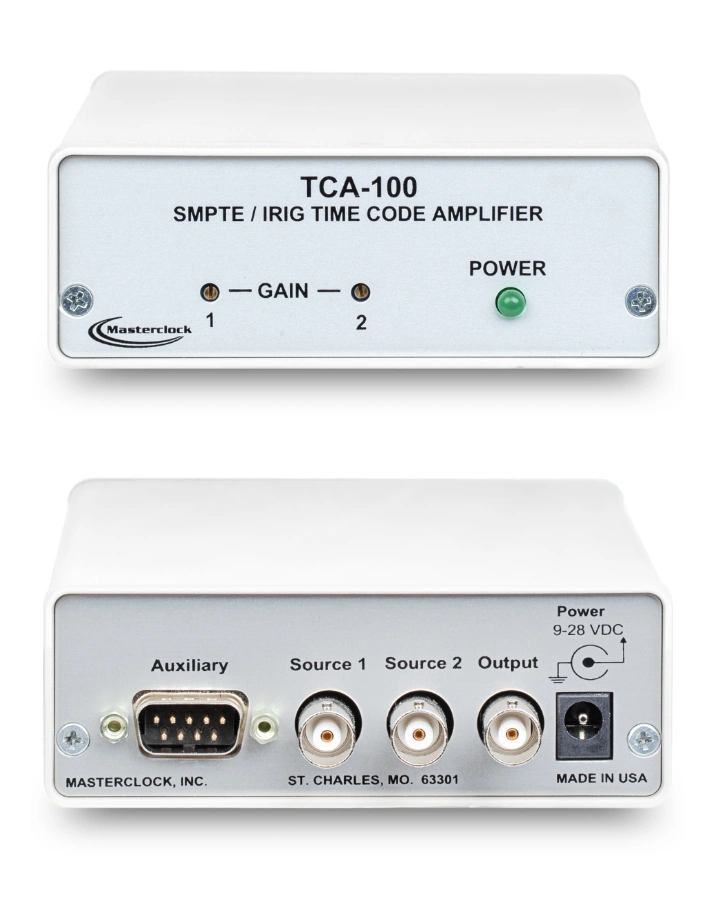
Our GMR grandmasters and time-code products deliver and process IRIG-B. Not sure which output you need? Tell us your setup.
From theory to practice: browse the time code products in the Masterclock range from Daylight.
Frame and modulation
An IRIG-B frame contains 100 bits per second (10 ms per bit), encoded via pulse width: index count, position identifiers, BCD time (seconds to days), optional year and straight binary seconds (SBS). The DCLS variant (B00x) provides the sharpest edge and therefore the best accuracy; the AM variant (B12x) modulates the same code on a 1 kHz carrier, easing transport over coax and longer distances at the cost of demodulation uncertainty.
Accuracy and chain
The achievable accuracy depends on cable delay, termination and demodulation. For DCLS the determining factor is edge detection; for AM the zero-crossing detection of the carrier. Compensate known cable delays where the application requires it.
Position in the time chain
IRIG-B is usually an output of a disciplined grandmaster (GNSS-disciplined, traceable to UTC). The code itself carries no uncertainty budget; the traceability comes from the source. See GNSS disciplining and stratum levels.
Migration
Many legacy installations run on IRIG-B. When modernising, an IRIG-B output is often still needed alongside NTP/PTP; choose a grandmaster that provides both. See replacing your time server.
Sources: IRIG Standard 200 (Range Commanders Council); IEEE 1588-2019; NIST Time & Frequency Division.Related products


Key terms
Further reading
Frequently asked questions? See the general FAQ on protocols, warranty, installation and support →
Need tailored advice?
Daylight bv has been the authorised Masterclock distributor since 2014. For advice on your specific situation, we are reachable 24/7.
Contact Daylight