

Masterclock Time Zone Clocks
Masterclock time zone clocks are multi-time-zone displays with location labels for trading floors, broadcast and operations control.

NTDS24-8AL
NTP Time Zone Clock 5,8 cm
More info
NTDS26-8AL
NTP Time Zone Clock 5,8 cm
More info
NTDS46-12AL
NTP Time Zone Clock 10,2 cm
More infoWorld clock: the time across multiple time zones at once
A world clock displays the time in different time zones around the world. It makes it easier to stay in touch with people in different parts of the world and to stay aware of the time in regions that matter for international business or travel.
Applications
This type of clock is widely used in international companies, travel agencies and airports, or by people who travel a lot or communicate with colleagues in different time zones. Other applications include call centres of international companies, the stock exchange, a trading room, and the reception hall of a company with offices in several countries.
Purpose
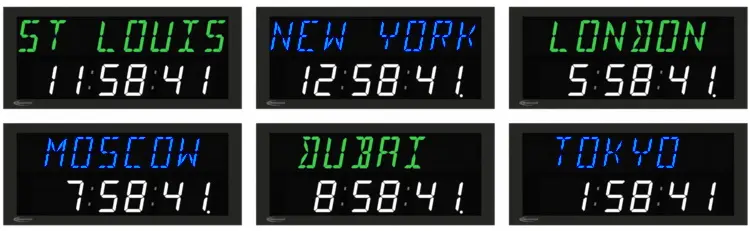
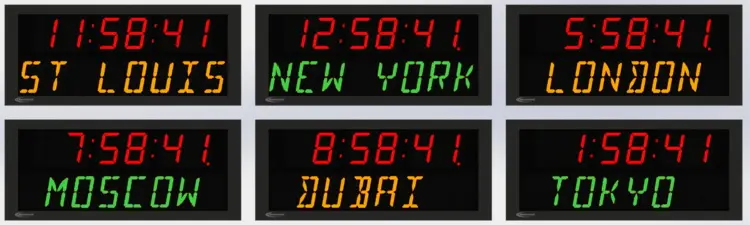
The world clock shows the time in several time zones at once. For example, we show the time in St. Louis, New York, London, Moscow, Dubai and Tokyo. Of course other cities can be shown too; these are just example cities.
How it works
You connect the clock to the network and the correct time is always synchronised with our time servers or internet time servers. The clock switches automatically between summer and winter time. In the settings you set the correct city and time zone for each display.
Display
11:58:41 (HH:MM:SS) or 11:58 (HH:MM) together with the city name, for example St. Louis.
What you should know about world clocks
- Time zones: there are 24 time zones in the world, set at longitudinal intervals of 15 degrees, beginning at the prime meridian in Greenwich, England. This is known as Greenwich Mean Time (GMT) or Coordinated Universal Time (UTC).
- Daylight saving time: some countries use daylight saving time, moving the clock one hour forward for more daylight during the summer months. Take this into account when configuring a world clock.
- Digital world clocks: digital world clocks exist both as physical displays and as software. They can usually be customised to show the time in specific time zones, and some also show the date, the day of the week and other useful information.
- 24-hour format: world clocks generally use the 24-hour format to avoid confusion between morning (AM) and afternoon (PM).
- World time: world time (UTC) is the time standard used to govern the time zones. It is based on atomic time, with small corrections to stay synchronised with the slightly varying speed of the Earth's rotation.
Sources and standards
This section refers to the following official standards and bodies: